

Rare Disease Advocacy, Biotechnology, and Investor (RDBI) Coalition’s Rare Disease Regulatory Sentiment Survey (2026)
Executive Summary
In March 2026, the Rare Disease Advocacy, Biotechnology, and Investor (RDBI) Coalition surveyed stakeholders across the rare disease ecosystem, including biotechnology investors, company executives and CEOs, rare disease patient advocates, and others, to assess the impact of the recent FDA regulatory environment on rare disease drug development, investment, and patient access. Findings were consistent across all three stakeholder groups: FDA regulatory unpredictability has emerged as a significant challenge to rare disease innovation in the United States.
Survey respondents across all groups described a regulatory environment in which agreed-upon endpoints, trial designs, and approval pathways are being revisited late in development, eroding the trust and predictability that rare disease development depends on.
Among biotechnology investors, respondents reported that FDA regulatory unpredictability has complicated rare disease capital allocation, with late-stage reversals of previously agreed-upon development frameworks making it difficult to underwrite long-term investment commitments in the sector.
Among biotechnology executives and CEOs, respondents cited a disconnect between the FDA’s stated commitments to regulatory flexibility and actual review division decisions, with direct consequences on development strategy.
Surveyed rare disease patient advocates identified a mismatch between the FDA’s evidentiary expectations and the practical constraints of rare disease research, including concerns about reduced use of advisory committees and requirements for trial designs that are difficult to implement in small patient populations with urgent unmet needs.
Taken together, these findings suggest that the current FDA regulatory environment is having measurable effects on rare disease investment, development activity, and patient access, with implications for the U.S competitiveness in the rare disease landscape.
Key Survey Findings
84% of investors reported reducing or pausing rare disease investments due to recent FDA regulatory developments.
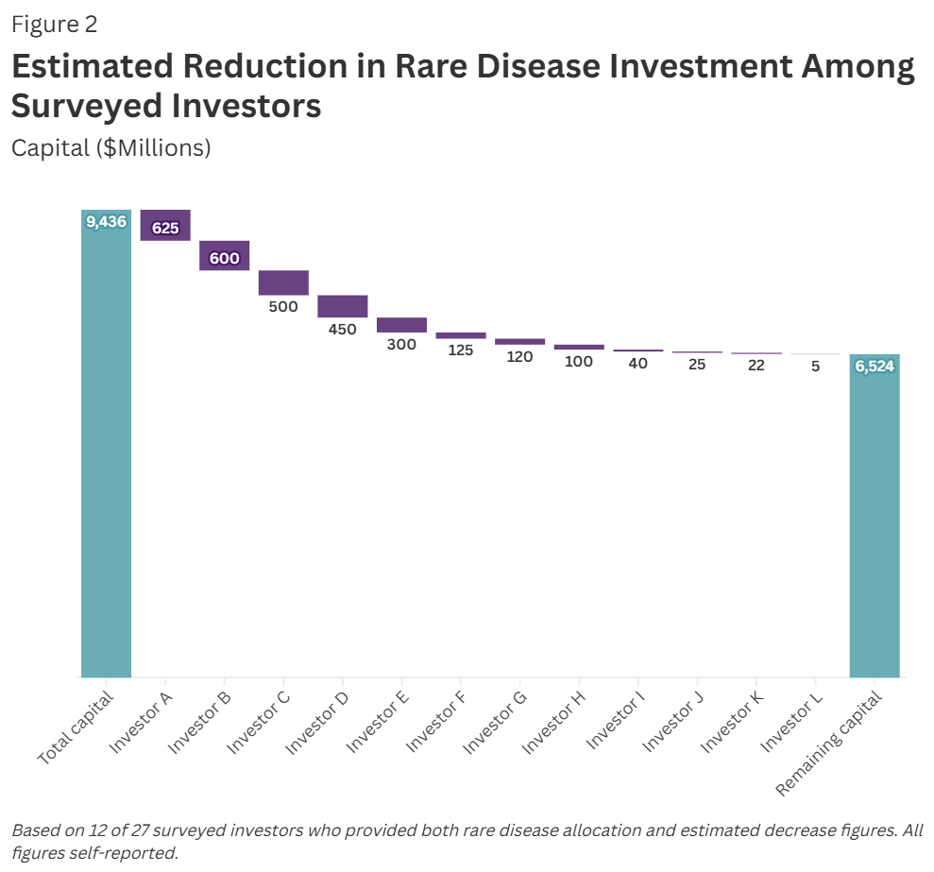
Surveyed investors estimate a total reduction of approximately $2.9 billion in rare disease investment.
78% of biotech executives report that the FDA is less predictable than it was two years ago.
68% of biotech executives report that FDA regulatory uncertainty has made it harder to raise capital over the past 12 months.
47% of biotech executives are considering or actively planning to move primary clinical operations abroad, while 17% have already moved.
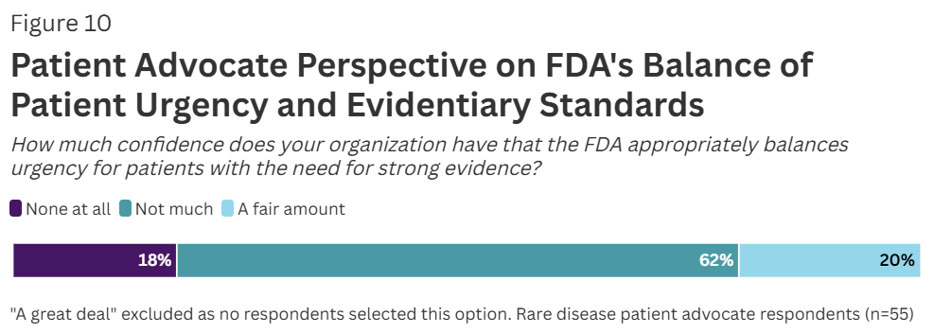
80% of patient advocates believe the FDA is not appropriately balancing urgency for patients with the need for strong evidence.
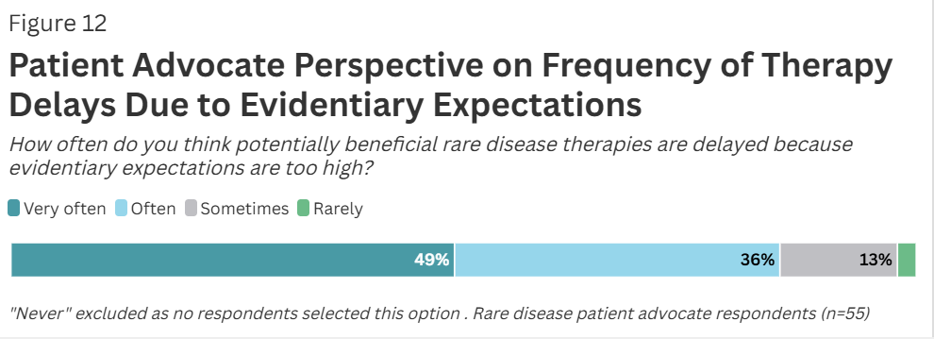
85% of surveyed patient advocates believe potentially beneficial rare disease therapies are often delayed due to high evidentiary expectations.
Methodology
Leveraging its network and distribution list developed through a prior coalition letter, Restoring Consistency and Innovation at the FDA, the RDBI partners distributed the survey to more than 200 stakeholders across the rare disease ecosystem, including patient advocacy organizations, biotech and pharmaceutical executives, and investors. A total of 143 stakeholders responded.
The survey was administered online between March 17 and March 27, 2026. Based on stakeholder type, respondents were directed to tailored question sets, with each participant answering approximately 10–15 multiple-choice questions and 2–3 open-ended questions.
Responses were collected anonymously, although respondents had the option to provide their signature as a supporter of the current RDBI coalition letter, Restoring Rare Disease Flexibility and Innovation at the FDA. Survey results are presented in aggregate and reflect both quantitative analysis and qualitative insights.
RDBI recognizes several limitations of this survey, starting with the survey’s sample size. While the sample size for patient advocates (n=55) and biotech executives (n=53) is sufficient to support meaningful descriptive analysis, the smaller sample of biotech investors (n=27) may limit the generalizability of findings. In addition, the survey may be subject to selection bias, as stakeholders who are more concerned about the current FDA regulatory environment may be more likely to respond. Nevertheless, the overall response volume (n=143) across a diverse set of stakeholders provides a meaningful snapshot of perspectives within the rare disease community.
Stakeholder Perspectives
Biotech Investors
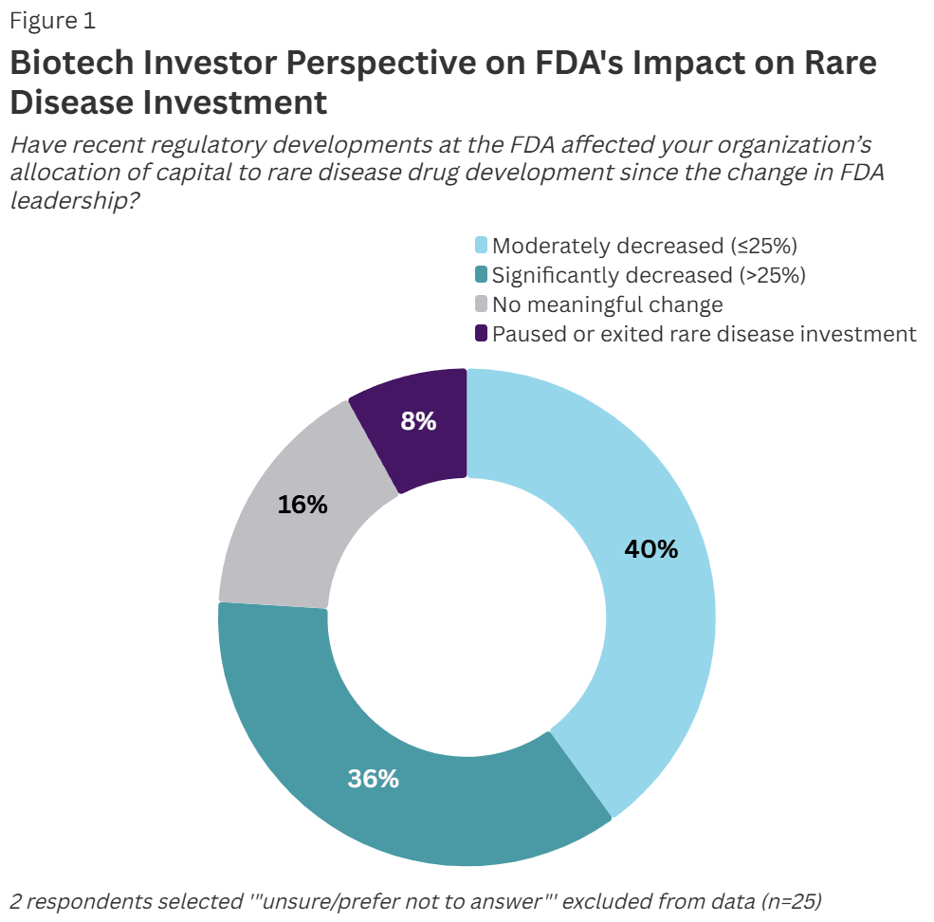
All biotech investor respondents (n=27) indicate that regulatory certainty and consistency are a critical factor in investment decisions. These investors range from smaller firms (approximately $70 million in AUM) to large institutional investors (approximately $30 billion in AUM). Across respondents, 84% reported that they have decreased, paused, or exited rare disease investments due to recent FDA regulatory uncertainty – Figure 1.
After aggregating investors’ estimated percentage reductions in rare disease investment allocations, the total reduction in capital is approximately $2.9 billion – Figure 2.
The FDA becoming more restrictive under the current leadership is a common concern cited across the three major stakeholder groups. All investor respondents who answered the question (n=26) said that the FDA is becoming more restrictive, with 38% describing it as “somewhat more restrictive” and 62% as “significantly more restrictive.”
When asked to provide additional context, investor responses referenced themes such as inconsistencies between prior FDA guidance and current decision-making, as well as increasing conservatism around the use of single-arm trials and surrogate endpoints. Many respondents noted that the core issue is not solely increasing regulatory restrictiveness, but rather a lack of clarity and consistency in the FDA’s recent feedback and decision-making processes.
Q12. If you believe the FDA’s regulatory approach to rare disease therapies has become more restrictive, please share any additional comments or examples that illustrate your perspective.
“In several recent cases...companies appear to have proceeded in good faith based on prior FDA feedback, only to encounter materially different requirements or interpretations at or near the point of submission. This introduces significant uncertainty into development timelines, capital allocation, and ultimately patient access...”
“Restrictive is not the right word - sometimes this agency has relaxed standards. But what investors need in order to allocate capital to long-term innovation projects is consistency and clarity from the FDA. This agency has been increasingly difficult to predict which increases underwriting risk, increases cost of capital, slows down industry growth, and slows down innovation of new medicines for patients.”
Biotech Executives
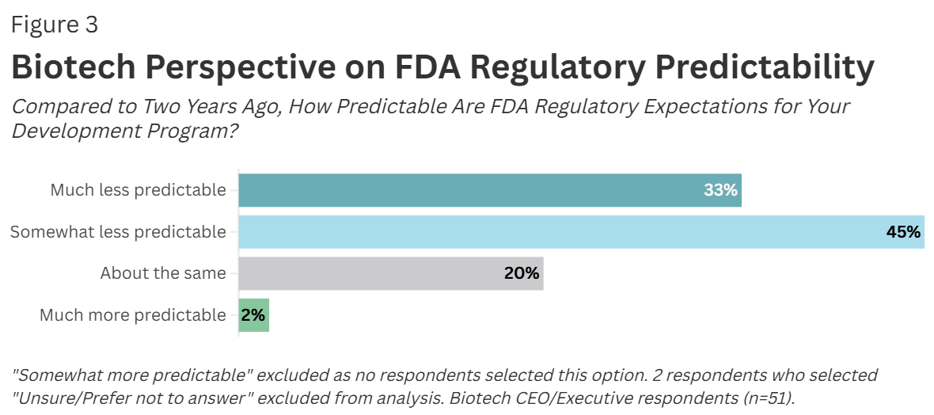
92% of biotech executive respondents report having interacted with the FDA in the past 12 months. Among these respondents, 78% indicate that the FDA’s regulatory expectations for their development programs have become less predictable compared to two years ago – Figure 3.
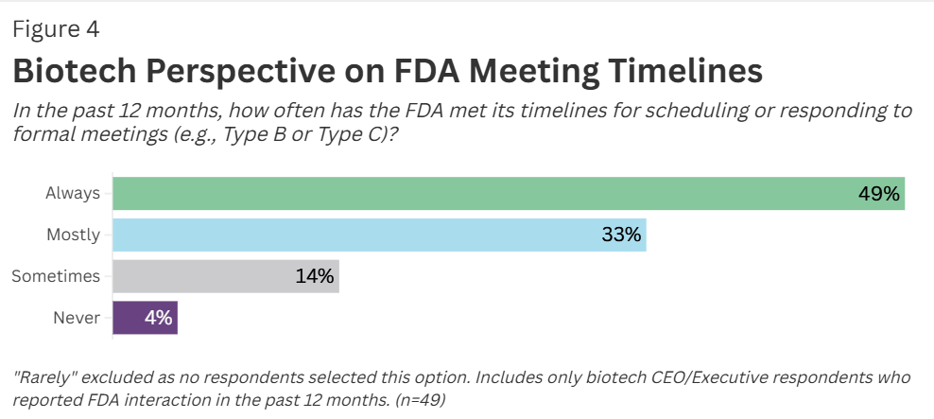
Interestingly, 82% report that the FDA has always or mostly met timelines for scheduling or responding to formal meetings – Figure 4.
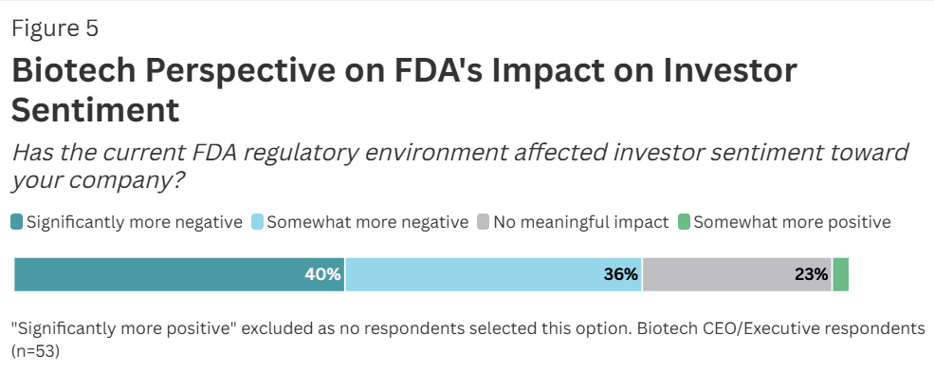
Approximately three-quarters report that the current regulatory environment has negatively affected investor sentiment toward their company – Figure 5; roughly two-thirds indicate that FDA-related uncertainty has made it more difficult to raise capital over the past 12 months.
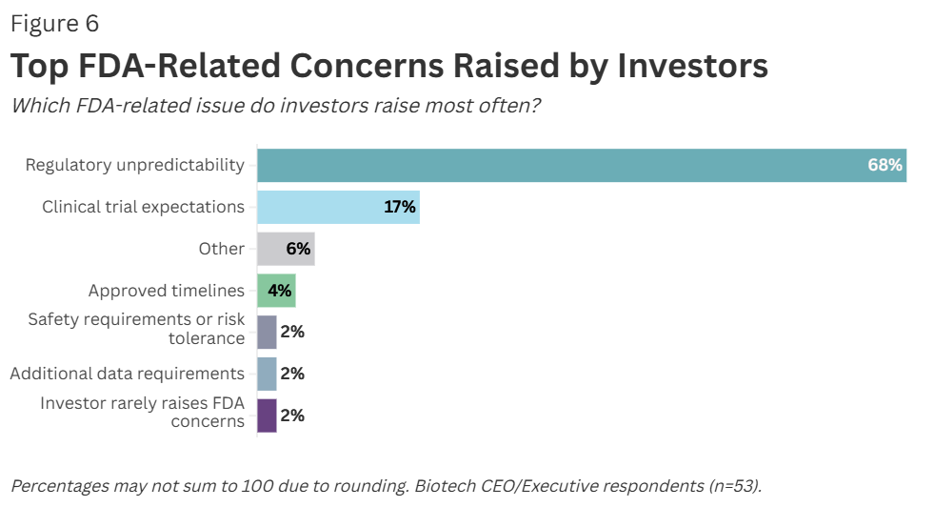
92% of biotech respondents report that investors more frequently raise FDA-related concerns during discussions. Among these, regulatory unpredictability is the most cited issue (68%), followed by clinical trial design expectations (17%) - Figure 6.
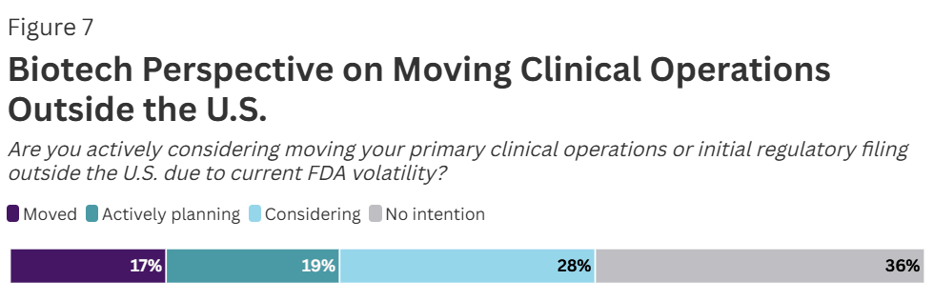
In response to perceived changes in FDA regulatory expectations, a majority of respondents report shifting or considering shifting their primary clinical operations or initial regulatory filings outside the United States, with 17% indicating they have already moved and 47% reporting that they are actively planning or considering such a move – Figure 7.
Patient Advocate Perspectives
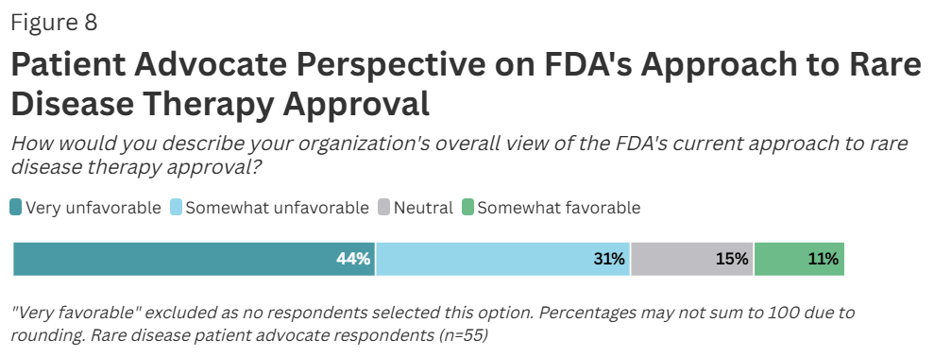
Similar to the other two stakeholder groups, a majority of patient advocates hold a negative view of the FDA’s current approach to rare disease therapies. Three-quarters of respondents find the FDA’s current approach unfavorable – Figure 8. A similar share believes the FDA is now less supportive of rare disease therapy development compared to two years ago.
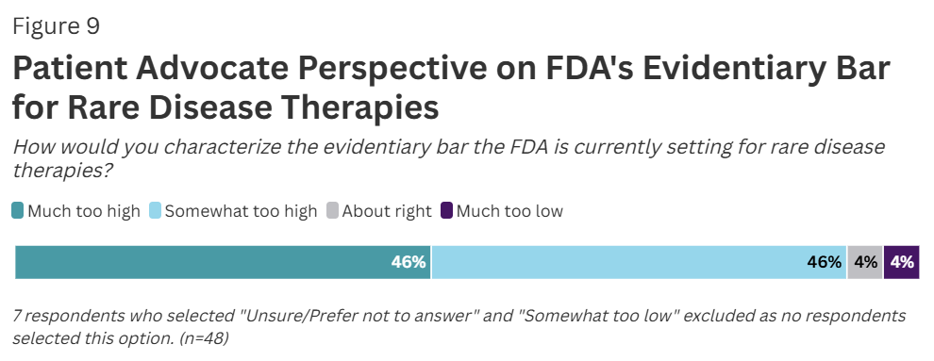
92% of rare disease advocate respondents believe the evidentiary bar at the FDA is too high – Figure 9. On a similar note, 80% believe the FDA is not appropriately balancing patient urgency with the need for stronger evidence – Figure 10. As an alternative, nearly all patient advocates agree that for life-threatening rare diseases with no approved treatments, the FDA should accept greater uncertainty at approval if confirmatory evidence can be collected afterward.
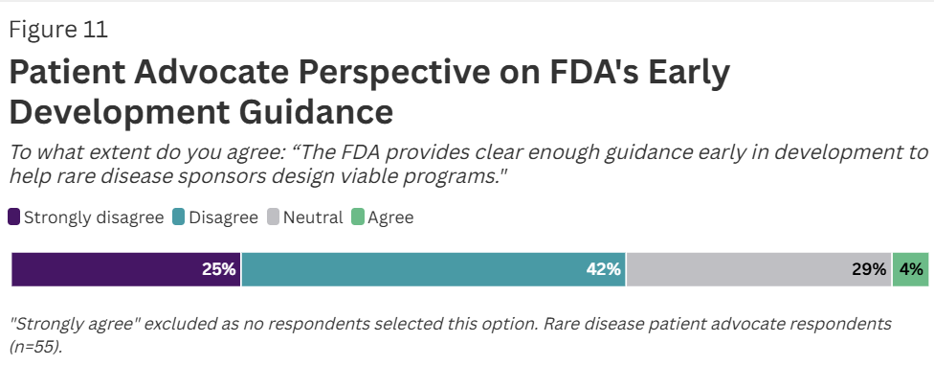
Compared to biotech executives, patient advocate respondents also expressed more negative views of the FDA’s feedback process. Only 4% of respondents agree that the FDA provides sufficiently clear guidance early in development to help rare disease sponsors design viable programs, while two-thirds disagree – Figure 11.
Patient advocates are concerned that high evidentiary standards, along with a lack of clear guidance from the FDA, may delay patient access. 85% of respondents believe that potentially beneficial rare disease therapies are often delayed because evidentiary expectations are too high – Figure 12.
When asked to provide more detail on the biggest problems with the FDA’s current evidentiary expectations for rare disease therapies, patient advocates more explicitly highlighted the recent wave of unexpected CRLs and regulatory reversals. Respondents frequently cited these cases as evidence of shifting standards, describing a “moving of the goalposts” and a growing hesitancy to accept natural history or real-world data.
Q47. What does your organization see as the biggest problem with the FDA’s current evidentiary expectations for rare disease therapies?
“The FDA’s evidentiary expectations for rare disease therapies is a mismatch between traditional approval standards and the realities of ultra small patient populations. Requirements rooted in large, randomized trials, validated endpoints, and replicated evidence are often impractical or even impossible when only a handful of patients exist and disease biology is poorly understood. Plus, there are inconsistent expectations, limited acceptance of alternative evidence like natural history or real-world data. There is a break between ensuring rigorous proof of safety and efficacy and enabling timely access to potentially lifesaving treatments in areas of extreme unmet need.”
“The recent wave of FDA reversals, late-cycle objections, and shifting evidentiary standards across multiple rare disease programs has led to a clear increase in unexpected CRLs and refusals despite expedited designations.”
Conclusion
This write-up summarizes and helps interpret results from the 2026 RDBI Rare Disease Regulatory Sentiment Survey. By capturing responses from 143 stakeholders across biotech investors, biotech executives/CEOs, and rare disease patient advocates, the survey provides a snapshot of current sentiment toward the FDA’s regulatory approach to rare disease drug development among key stakeholders in the healthcare ecosystem.
All stakeholders expressed concerns about uncertainty and a lack of transparency in the FDA’s evidentiary standards for rare diseases, as well as the agency’s conservatism in accepting greater uncertainty and flexible evidence when approving rare disease therapies. These concerns have been translated into concrete actions, including reduced investment in rare diseases by biotech investors and companies shifting clinical operations abroad.
For full survey results, please refer to Appendix A. For additional context and discussion of rare disease regulatory challenges, please refer to the RDBI Coalition’s recent comment letter to the White House and the FDA.

